The idea for our publication is that its an educational book to be realised with a promotional event, so far this event is going to include a lecture on the content of our book on the date of 2013's summer solstice to tie in with astrology relating to the Egyptians beliefs. To keep consistent to the artwork I've been producing I've designed the tickets using the same stamp border, Tickets will be sent out to selected museums universities and book shops and customers will receive a stamp on entry. I havent developed the colour scheme as of yet but I think this will come together as my final images begin to progress.
Sunday, 12 May 2013
Brief 4 : Stamps
I've been collecting images from across the internet of Egyptian stamps to get some ideas for the limited edition posters that are going to go with the pack. I love the way their laid out with thick boarders and two or more typefaces, one Eygptian arabic and one english. I think It would be really nice to produce some artwork in a similar style to correspond with our publication, I think the style of these stamps could work really well with the technique I've experimented with in laser cutting.
http://www.timstouse.com/EarthHistory/Egypt/GreatPyramid/interestingfacts.htm
Interesting facts about the 8 sides of a pyramid to use within y first test piece.
http://cassiopaea.org/forum/index.php?topic=27990.0
The Concave Faces of the Great Pyramid
Aerial photo by Groves, 1940 (detail).

In his book The Egyptian Pyramids: A Comprehensive, Illustrated Reference, J.P. Lepre wrote:
One very unusual feature of the Great Pyramid is a concavity of the core that makes the monument an eight-sided figure, rather than four-sided like every other Egyptian pyramid. That is to say, that its four sides are hollowed in or indented along their central lines, from base to peak. This concavity divides each of the apparent four sides in half, creating a very special and unusual eight-sided pyramid; and it is executed to such an extraordinary degree of precision as to enter the realm of the uncanny. For, viewed from any ground position or distance, this concavity is quite invisible to the naked eye. The hollowing-in can be noticed only from the air, and only at certain times of the day. This explains why virtually every available photograph of the Great Pyramid does not show the hollowing-in phenomenon, and why the concavity was never discovered until the age of aviation. It was discovered quite by accident in 1940, when a British Air Force pilot, P. Groves, was flying over the pyramid. He happened to notice the concavity and captured it in the now-famous photograph. [p. 65]
This strange feature was not first observed in 1940. It was illustrated in La Description de l'Egypte in the late 1700's (Volume V, pl. 8). Flinders Petrie noticed a hollowing in the core masonry in the center of each face and wrote that he "continually observed that the courses of the core had dips of as much as ½° to 1°" (The Pyramids and Temples of Gizeh, 1883, p. 421). Though it is apparently more easily observed from the air, the concavity is measurable and is visible from the ground under favorable lighting conditions.
Ikonos satellite image of the Great Pyramid.
Interesting facts about the 8 sides of a pyramid to use within y first test piece.
http://cassiopaea.org/forum/index.php?topic=27990.0
The Concave Faces of the Great Pyramid
Aerial photo by Groves, 1940 (detail).
In his book The Egyptian Pyramids: A Comprehensive, Illustrated Reference, J.P. Lepre wrote:
One very unusual feature of the Great Pyramid is a concavity of the core that makes the monument an eight-sided figure, rather than four-sided like every other Egyptian pyramid. That is to say, that its four sides are hollowed in or indented along their central lines, from base to peak. This concavity divides each of the apparent four sides in half, creating a very special and unusual eight-sided pyramid; and it is executed to such an extraordinary degree of precision as to enter the realm of the uncanny. For, viewed from any ground position or distance, this concavity is quite invisible to the naked eye. The hollowing-in can be noticed only from the air, and only at certain times of the day. This explains why virtually every available photograph of the Great Pyramid does not show the hollowing-in phenomenon, and why the concavity was never discovered until the age of aviation. It was discovered quite by accident in 1940, when a British Air Force pilot, P. Groves, was flying over the pyramid. He happened to notice the concavity and captured it in the now-famous photograph. [p. 65]
This strange feature was not first observed in 1940. It was illustrated in La Description de l'Egypte in the late 1700's (Volume V, pl. 8). Flinders Petrie noticed a hollowing in the core masonry in the center of each face and wrote that he "continually observed that the courses of the core had dips of as much as ½° to 1°" (The Pyramids and Temples of Gizeh, 1883, p. 421). Though it is apparently more easily observed from the air, the concavity is measurable and is visible from the ground under favorable lighting conditions.
Ikonos satellite image of the Great Pyramid.

I.E.S. Edwards wrote, "In the Great Pyramid the packing-blocks were laid in such a way that they sloped slightly inwards towards the centre of each course, with a result that a noticeable depression runs down the middle of each face -- a peculiarity shared, as far as is known, by no other pyramid" (The Pyramids of Egypt, 1975, p. 207). Maragioglio and Rinaldi described a similar concavity on the pyramid of Menkaure, the third pyramid at Giza. Miroslav Verner wrote that the faces of the Red Pyramid at Dahshur are also "slightly concave."
_______________________________________________________________________________
http://www.world-mysteries.com/mpl_2.htm - amazing link for source material
_______________________________________________________________________________
Below I've started to construct my own stamp on Illustrator working similar to the ones i've collected from around the internet. I thought the relief of a stamp could work really nicely in tying in with hieroglyphs and the cutting of pyramid walls. I've imitated the 1920's stamp with both Egyptian Arabic and English however the typeface i've used is called alhambra and is an imitation of an Arabic set of letters however it read english.
The artwork I',m started to produce is for the limited edition posters, promotional material and jigsaw puzzle. Each plaque is going to imitative a different style of stamp and each contain a different interesting set of facts about the pyramids. This particular one is going to be about the 8 sides of pyramid Khufu, a common mis-perception.


Below I've started to construct my own stamp on Illustrator working similar to the ones i've collected from around the internet. I thought the relief of a stamp could work really nicely in tying in with hieroglyphs and the cutting of pyramid walls. I've imitated the 1920's stamp with both Egyptian Arabic and English however the typeface i've used is called alhambra and is an imitation of an Arabic set of letters however it read english.
The artwork I',m started to produce is for the limited edition posters, promotional material and jigsaw puzzle. Each plaque is going to imitative a different style of stamp and each contain a different interesting set of facts about the pyramids. This particular one is going to be about the 8 sides of pyramid Khufu, a common mis-perception.


Thursday, 9 May 2013
Brief 4 : Star Constellation Puzzle
Another piece of relavent context I picked up today was a puzzle of the star constellations, I found it in a charity shop and thought I'd pick it up out of interest in relation to our brief.
In terms of concept building and other deliverables I intend on taking some of our final artwork to print, mounting it on thick mount board and using the laser cutter or jigsaw cut the print into pieces of a puzzle. As an educational pack with event running alongside I think a jigsaw puzzle would be a good educational deliverable.
In terms of concept building and other deliverables I intend on taking some of our final artwork to print, mounting it on thick mount board and using the laser cutter or jigsaw cut the print into pieces of a puzzle. As an educational pack with event running alongside I think a jigsaw puzzle would be a good educational deliverable.


Brief 4 : Sacred Geometry
I've been spending alot of time looking into the geometry relating to the pyramids and exploring the construction of the pyramids of giza. Geometric shapes that recur throughout life's complexity have been used in the construction of the Pyramids of Giza and are shown below. I've vectored logo's of the symbols we intend on using for our publication. These will be short points about shapes that relate the Pyramids construction.
The pages from the book below were a very big inspiration.
Below I've started to make some of the symbols that need to be used, I've tried to keep them as basic as possible using a thick weight.
Brief 4 : Orion Theory, Planets, Constellations and Painting
Other than researching the Egyptian Pyramids, Our main theory talks about the position of the pyramids of Giza and their alignment within the star constellation. I've been collecting digrams and imagery to work from relating to space, nebulas and the constellations. Below is a brief bit of information collected to do with the main theory we're working with.


The Orion Theory
Before proceeding, it is important to clarify that Eric Wilson did not personally hypothesize the theory unto which we shall soon focus.
The theory was originally presented by Robert Bauval and Adrian Gilbert in The Orion Mystery. Subsequently, the hypothesis has been espoused on several television specials and documentaries.
Robert Bauval discovered what Egyptologists have overlooked for centuries.
He simply superimposed the constellation of Orion (which Dynastic Egypt considered the celestial counterpart of their god Osiris) onto the terra of Giza and surrounding regions. The idea was that the three belt stars of Orion: Alnitak, Alnilam, and Mintaka, coincide precisely via angular alignments to the three pyramids at Giza: Khufu, Khafre, and Menkaure.
If this correlation were correct, then one would expect that other structures might coincide with the other stars in the constellation. Indeed, Bauval claimed to have located two such structures. (For reference, all pyramids correlating to the Orion constellation shall be referred to as "Orion Pyramids". Those include the 3 pyramids at Giza as well as the pyramids at Abu Ruwash and Zawyat Al Aryan).
According to Bauval, the remains of a pyramid north of Giza at Abu Ruwash and similar remains south of Giza at Zawyat Al Aryan seemed to correlate to the stars Saiph and Bellatrix. Saiph is the star considered to be Orion's right knee and Bellatrix is Orion's left shoulder (using Orion's perspective rather than Earth's).
Wilson was intrigued by Bauval's original proposal, but apparently found an incongruity. It appeared that Bauval had incorrectly placed the superimposition of Orion onto the topography of Giza. Wilson found that based upon the precise relationship of angulation between the three pyramids at Giza and the stars in Orion's belt, the terrestrial coordinates for Saiph and Bellatrix would not place them at Abu Ruwash and Zawyat Al Aryan, but elsewhere.
Even more intriguing, Wilson discovered that the pyramids present at Abu Ruwash and Zawyat Al Aryan aligned perfectly to the right ascension and declination (celestial latitude and longitude) of the stars Rigel (Orion's left knee) and Betelgeuse (Orion's right shoulder).
In other words, Wilson discovered that by swiveling the constellation so that the star Rigel lay over the pyramid at Abu Ruwash, and the star Betelgeuse lay over the pyramid at Zawyat Al Aryan, the angulation became exact!
Using the Global Positioning Satellite System (Wilson was able to enter his knowns - i.e. the positions of the pyramids at Giza), and calculate the longitudinal and latitudinal positions of Orion's stars relative to their right ascensions and declinations. Then it was simply a matter of letting the United States' 24 orbiting satellites show the way, as they did for us in December, 1996.
Not only did the GPS confirm Abu Ruwash and Zawyat Al Aryan as the stars Rigel and Betelgeuse, but it predicted the true locations for Saiph and Bellatrix. Wilson succeeded in locating these positions and found evidence that subterranean remains still exist, and/or structures one existed, at both sites.
However, Wilson calculated the terrestrial positions for the stars that make up Orion's head (Meissa) and dagger (M42/M43). Additionally, Wilson located the terrestrial position for the star Leporis in the constellation of Lepus (adjacent to Orion).
All three of these sites exhibit curious evidence in support of The Orion Pyramid Theory.
_________________________________________________________________________________
Below I have collected a variety of images of space to get me inspired to create artwork for mine and Oli's limited edition posters to go alongside our publication. I've been intending on going on a research visit to Jodrell Bank in Cheshire, a very large satellite dish which is open to the public and provides information on the stars. I've been chatting to a few different people who suggested I go down to Vernon Street and rent out their books on the constellations as they have a huge range of material.
Outside of our the FMP, I've been working on a space themed painting in someones house for an art event taking place over the weekend. Even though this isn't part of my FMP I've been working with spray paint to create geometrical patterns and shapes relating to space. I think this process off splattering and layering paint could be an awesome way to quickly produce covers that are completely unique.


Brief 4 : Tutankhamen
Today I was on the Market and spotted a couple of Egyptian bits and bobs on a second hand stall. For subject matter and imagery to draw I picked up this Tutankhamen head for a fiver! I watched a documentary on the 19th dinesty of royalty within Eygpt covering Tutankhamen so I thought this would be really relavent to sketch from in relation to mine and Oli's brief.

I plan on Photographing this head from a variety of angles to draw from or produce some collage from. This will be documented as I go along.
King Tut is chiefly known for his intact tomb, discovered in Egypt's Valley of the Kings in 1922. Since then, his remains have held millions in awe over the mystery of his life and death.
NAME: King Tut
OCCUPATION: King
BIRTH DATE: c. 1341 BCE
DEATH DATE: c. 1323 BCE
PLACE OF BIRTH: Egypt
PLACE OF DEATH: Egypt
ORIGINALLY: Tutankhaten
AKA: Tutankhamen
AKA: Tutankhamun
AKA: King Tut
AKA: The Boy King of Egypt
AKA: The Boy King
AKA: The Boy Pharaoh
AKA: Boy Pharaoh Tutankhamun
Brief 4 : Liverpool World Museum
Today I went to the Liverpool World museum to gather some further research into the world of the Egyptians for mine and Oli's brief. The trip was well worth while and I managed to get loads of photographs to draw from, The plaques that were in the museum provided a really good understanding of what I was looking at whilst at the same time will be really good information for me and Oli to use.
Brief 4 : Vector Digrams & Publication Planning
Today me and Oli had a briefing and crit between the two of us and refined some of the roles and tasks we need to be completing. We also came up with a complete plan and layout of the content for our book as you can see below.


My role within our team, is mainly working with creating the diagrams and vectors for our book whilst also completing some illustrations and collating information/images for Oli to lay out. I've spent a lot of time researching and getting really interested in the subject matter we're using so now I've started to work with this within Illustrator as you can see below.
Brief 4 : Creating my own Hieroglyphs
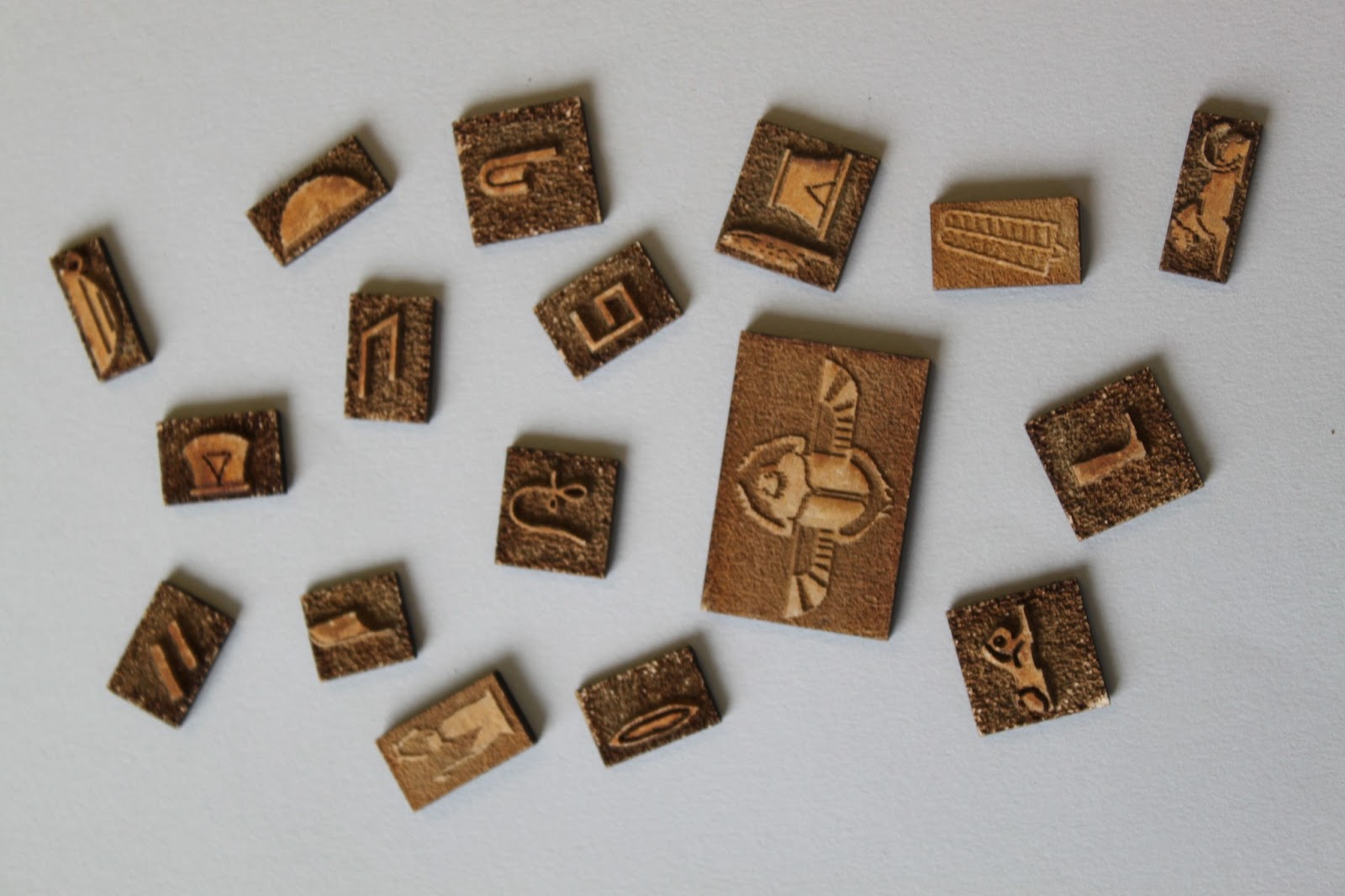
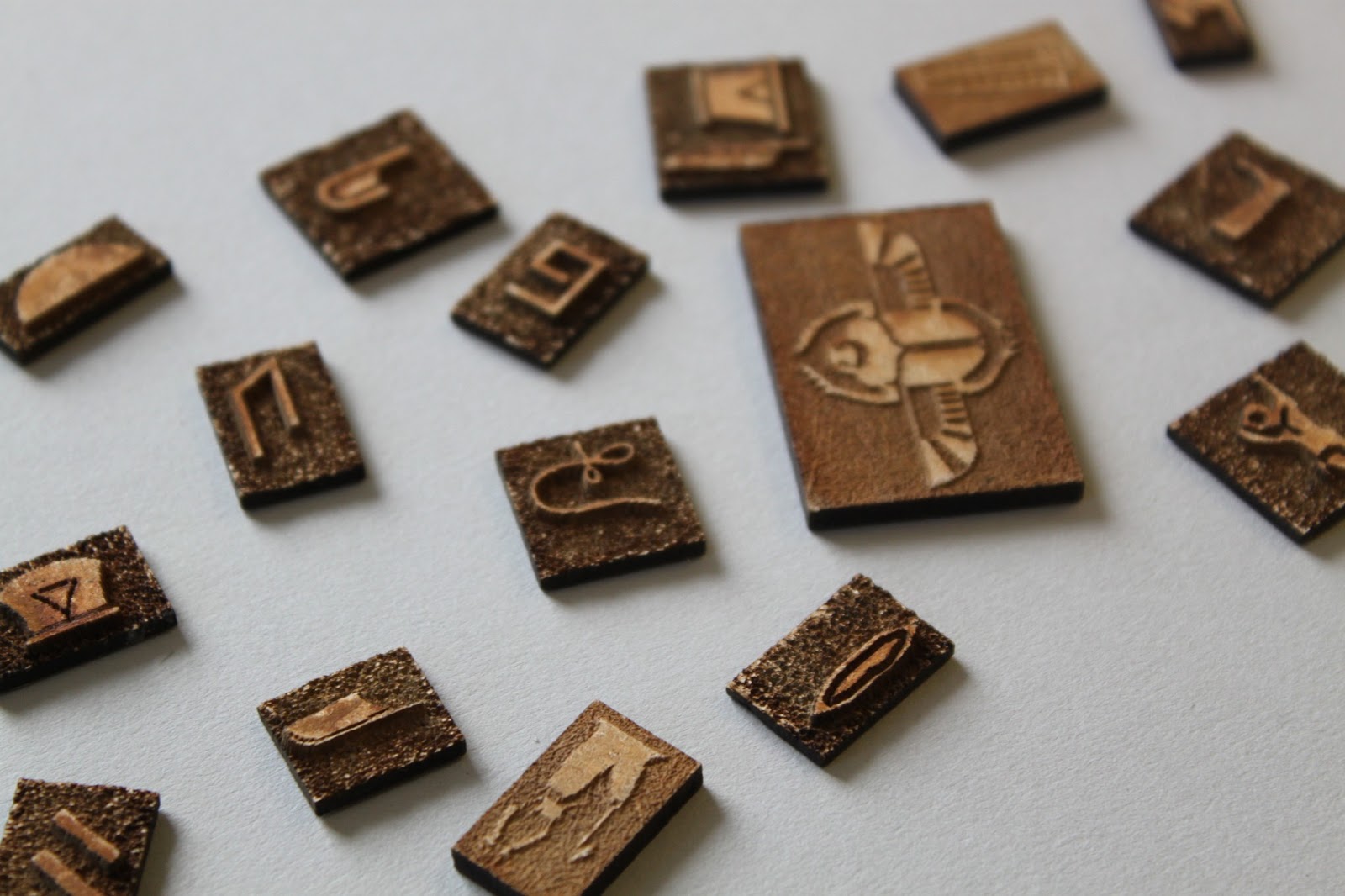
After visiting lots of different museums and galleries I started to brainstorm and think about the application of type within mine and oli's publication. The Egyptian had lots of rules when It came to communication and looking into how hieroglyphs are used has inspired me to create my own set of wooden embossing stamps. I thought to imitate the relief of the characters on the walls of the pyramids, laser cutting small hieroglyphs to be rolled with stock would create a similar effect.
The concept so far is to use a different hieroglyphs as the symbol/logo for each chapter of our publication. As we are dealing with a lot of numbers It could be that we use hieroglyphs as our page numbers. The ruling for Egyptian numbers is below.
_________________________________________________________________________________
The ancient Egyptians were possibly the first civilisation to practice the scientific arts. Indeed, the word chemistry is derived from the word Alchemy which is the ancient name for Egypt. Where the Egyptians really excelled was in medicine and applied mathematics. But although there is a large body of papyrus literature describing their achievements in medicine, there are no records of how they reached their mathematical conclusions. Of course they must have had an advanced understanding of the subject because their exploits in engineering, astronomy and administration would not have been possible without it.
The Egyptians had a decimal system using seven different symbols.
1 is shown by a single stroke.
10 is shown by a drawing of a hobble for cattle.
100 is represented by a coil of rope.
1,000 is a drawing of a lotus plant.
10,000 is represented by a finger.
100,000 by a tadpole or frog
1,000,000 is the figure of a god with arms raised above his head.

_________________________________________________________________________________
Making my Own Hieroglyphs, I started by vectoring out and creating some characters in Illustrator to work from. When working with the laser cutting I made the hieroglyph white and the surrounding area black, when using the laser cutting under the raster setting It removed 2mm of wood in the black areas out of 4mm plywood. Some of my experiments are below.
This is the Imagery I started off with, before taking it to laser cutting.
This is the Imagery I started off with, before taking it to laser cutting.


Below are the final wooden blocks I created, I'm happy with the result so far, I had to tweak some issues on the laser cutter, setting the raster to repeat twice so that the cut was much deeper and imagery became more detailed.





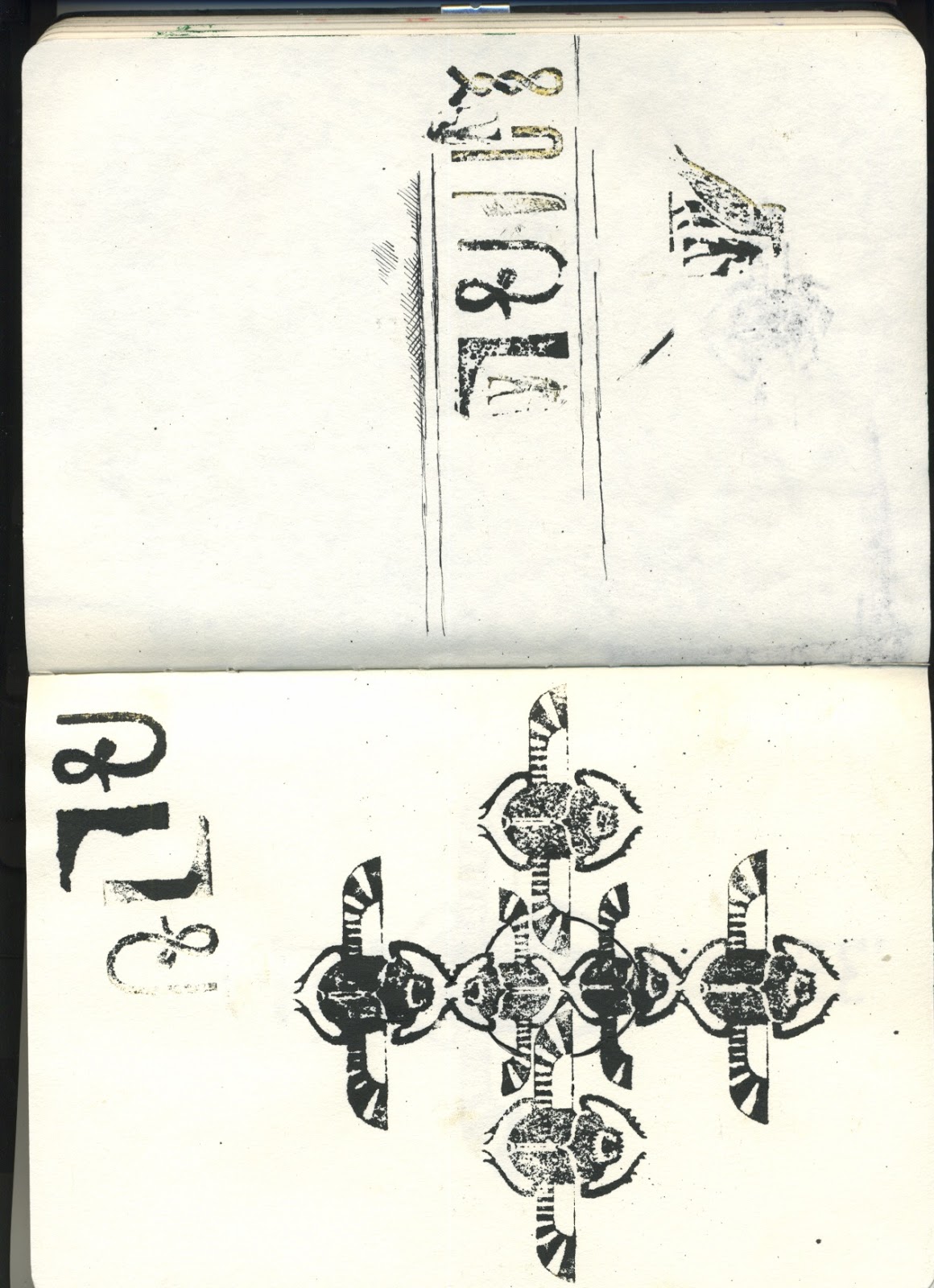
Further experimentation included using a really thin black quink ink to use them like wooden printing blocks. Next time a thicker ink needs to be used, but I am happy with the progress I've made with this process. If repeated on a larger scale, following the same rules applied to screen printing when using layers I think there could be potential using blocks similar to this to create the artwork to go alongside our publication.



Brief 4 : Leeds City Museum and more research Into Eygpt
Today I went round Leeds city Art gallery and also met up with Oli to discuss our briefs. The museum was again another insight into the vast subject matter we've chosen to base our publication on, Egypt truly fascinates me and I'm overwhelmed each time I see a sarcophagus or mummy, the thought that that person still reamins in-tact after years of existing baffles me. Below are some photographs from the Museum.
Page plans for our book.
Over the past few weeks, me and Oli have been conducting lots of research around the Pyramids and their relaitionship with the constellations. We have derived lots of different chapters of research including, lifestyle, food, diet, artifacts, tools symbolism, mythology, Gods, How the pyramids were built, Intricacy in design, Sacred geometry, interesting facts and theories. So our content doesn't wander and so that we don't start to write a book that becomes a life-long dedication to Egyptology, we've started to plan out what we want to have on each spread across the whole publication. This is show below in some of the photographs I've taken. This has also given us the ability to further define our roles as designers, working on the publication together Oli is going to deal with type and layout and I will be dealing with image making and illustration, we will derive the content together.
 The flower of Life
Recently I've been collecting lots of information on sacred geometry and how the pyramids were build using geometrical shapes and patterns that recure throughout maths and science today. The flower of life is a shape that is meant to be fundamental in every aspect of life and the Universes is designed around it. For our opening page, we want to give readers a quick short snappy insight to get them thinking before even beginning to fathom the rest of our content. I've been researching into the flower of life so we have a good strong symbol and shape to house our contents page and to instantly inspire readers.
________________________________________________________________________________
http://www.phoenixmasonry.org/sacred_geometry_the_flower_of_life.htm
The flower of life shape contains a secret shape known as the fruit of life that consists of 13 spheres that hold many mathematical and geometrical laws. These laws represent the whole universe. Giving the flower of life to someone is like giving them the whole universe in one jewel. The Flower of Life can be found in all major religions of the world. In Egypt, the source of all the monotheistic religions, the "Flower of Life", can be found in the ancient Temple of Abydos. In Israel, it can be found in ancient synagogues in the Galilee and in Mesada. People reported physical and psychological changes after wearing this pendant - faster heart beats, prophetic dreams, breaking of illusions, seeing the reality as it is and becoming free from long time fears. The flower of life is one of the strongest sacred geometric shapes!


http://en.wikipedia.org/wiki/Flower_of_Life
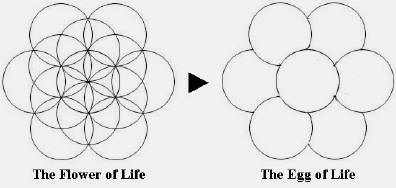
The Flower of Life is the name coined by New Age author Drunvalo Melchizedek for a geometrical figure composed of multiple evenly-spaced, overlapping circles. This figure, used as a decorative motif since ancient times, forms a flower-like pattern with the symmetrical structure of a hexagon.
A "Flower of Life" figure consists of seven or more overlapping circles, in which the center of each circle is on the circumference of up to six surrounding circles of the same diameter. However, the surrounding circles need not be clearly or completely drawn; in fact, some ancient symbols that are claimed as examples of the Flower of Life contain only a single circle or hexagon.
New Age followers ascribe many forms of significance to the Flower of Life and three similar figures, called the "Egg of Life," the "Fruit of Life," the "Seed of Life,"and the "Tree of Life." Melchizedek and others assert that these figures are symbols of sacred geometry, that they represent ancient spiritual beliefs, and that they depict fundamental aspects of space and time. They claim that Metatron's Cube may be derived from the Flower of Life pattern, and that the Platonic solids within it were "thought to act as a template from which all life springs."
The Flower of Life and the Seed of Life are linked by New Age authors with the Biblical prophet Enoch, the Archangel Metatron, the six days of Creation, the Vesica Piscis religious symbol, and Borromean rings
It was originally thought that the Temple of Osiris in Abydos, Egypt contained the oldest known examples of the Flower of Life. It is now known that an earlier example of the pattern can be seen in the Assyrian rooms of theLouvre Museum in Paris. The design forms part of a gypsum or alabaster threshold step measuring 2.07 x 1.26 meters (6.8 x 4.1 feet) that originally existed in one of the palaces of King Ashurbanipal, and has been dated to c. 645 BC.
The Abydos examples from Egypt are also worthy of note. Claims that they are over 6,000 years old and may date back to as long ago as 10,500 BC. or earlier have not yet been confirmed. Recent research shows that these symbols can be no earlier than 535 B.C., and most probably date to the 2nd and 4th century AD, based on photographic evidence of Greek text, still to be fully deciphered, seen alongside the Flower of Life circles and the position of the circles close to the top of columns, which are over 4 metres in height. This suggests the Osirion was half filled with sand prior to the circles being drawn and therefore likely to have been well after the end of the Ptolemaic dynasty.
_________________________________________________________________________________


Page plans for our book.
Over the past few weeks, me and Oli have been conducting lots of research around the Pyramids and their relaitionship with the constellations. We have derived lots of different chapters of research including, lifestyle, food, diet, artifacts, tools symbolism, mythology, Gods, How the pyramids were built, Intricacy in design, Sacred geometry, interesting facts and theories. So our content doesn't wander and so that we don't start to write a book that becomes a life-long dedication to Egyptology, we've started to plan out what we want to have on each spread across the whole publication. This is show below in some of the photographs I've taken. This has also given us the ability to further define our roles as designers, working on the publication together Oli is going to deal with type and layout and I will be dealing with image making and illustration, we will derive the content together.
 The flower of Life
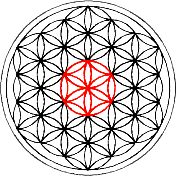
Recently I've been collecting lots of information on sacred geometry and how the pyramids were build using geometrical shapes and patterns that recure throughout maths and science today. The flower of life is a shape that is meant to be fundamental in every aspect of life and the Universes is designed around it. For our opening page, we want to give readers a quick short snappy insight to get them thinking before even beginning to fathom the rest of our content. I've been researching into the flower of life so we have a good strong symbol and shape to house our contents page and to instantly inspire readers.
________________________________________________________________________________
http://www.phoenixmasonry.org/sacred_geometry_the_flower_of_life.htm
The flower of life shape contains a secret shape known as the fruit of life that consists of 13 spheres that hold many mathematical and geometrical laws. These laws represent the whole universe. Giving the flower of life to someone is like giving them the whole universe in one jewel. The Flower of Life can be found in all major religions of the world. In Egypt, the source of all the monotheistic religions, the "Flower of Life", can be found in the ancient Temple of Abydos. In Israel, it can be found in ancient synagogues in the Galilee and in Mesada. People reported physical and psychological changes after wearing this pendant - faster heart beats, prophetic dreams, breaking of illusions, seeing the reality as it is and becoming free from long time fears. The flower of life is one of the strongest sacred geometric shapes!
http://en.wikipedia.org/wiki/Flower_of_Life
The Flower of Life is the name coined by New Age author Drunvalo Melchizedek for a geometrical figure composed of multiple evenly-spaced, overlapping circles. This figure, used as a decorative motif since ancient times, forms a flower-like pattern with the symmetrical structure of a hexagon.
A "Flower of Life" figure consists of seven or more overlapping circles, in which the center of each circle is on the circumference of up to six surrounding circles of the same diameter. However, the surrounding circles need not be clearly or completely drawn; in fact, some ancient symbols that are claimed as examples of the Flower of Life contain only a single circle or hexagon.
New Age followers ascribe many forms of significance to the Flower of Life and three similar figures, called the "Egg of Life," the "Fruit of Life," the "Seed of Life,"and the "Tree of Life." Melchizedek and others assert that these figures are symbols of sacred geometry, that they represent ancient spiritual beliefs, and that they depict fundamental aspects of space and time. They claim that Metatron's Cube may be derived from the Flower of Life pattern, and that the Platonic solids within it were "thought to act as a template from which all life springs."
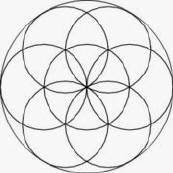
The Flower of Life and the Seed of Life are linked by New Age authors with the Biblical prophet Enoch, the Archangel Metatron, the six days of Creation, the Vesica Piscis religious symbol, and Borromean rings
It was originally thought that the Temple of Osiris in Abydos, Egypt contained the oldest known examples of the Flower of Life. It is now known that an earlier example of the pattern can be seen in the Assyrian rooms of theLouvre Museum in Paris. The design forms part of a gypsum or alabaster threshold step measuring 2.07 x 1.26 meters (6.8 x 4.1 feet) that originally existed in one of the palaces of King Ashurbanipal, and has been dated to c. 645 BC.
The Abydos examples from Egypt are also worthy of note. Claims that they are over 6,000 years old and may date back to as long ago as 10,500 BC. or earlier have not yet been confirmed. Recent research shows that these symbols can be no earlier than 535 B.C., and most probably date to the 2nd and 4th century AD, based on photographic evidence of Greek text, still to be fully deciphered, seen alongside the Flower of Life circles and the position of the circles close to the top of columns, which are over 4 metres in height. This suggests the Osirion was half filled with sand prior to the circles being drawn and therefore likely to have been well after the end of the Ptolemaic dynasty.
_________________________________________________________________________________
http://www.tokenrock.com/explain-Flower-of-Life-46.html
Possibly five Flower of Life patterns can be seen on one of the granite columns and a further five on a column opposite of the Osirion. Some are very faint and hard to distinguish.
SEED OF LIFE
The 'Seed of Life' is formed from seven circles being placed with sixfold symmetry, forming a pattern of circles and lenses, which acts as a basic component of the Flower of Life's design. According to some, the seed of life depicts the 7 days of creation in which God created life.
EGG OF LIFE
The 'Egg of Life' is also a symbol composed of seven circles taken from the design of the Flower of Life.The shape of the Egg of Life is said to be the shape of a multi-cellular embryo in its first hours of creation.
FRUIT OF LIFE
The 'Fruit of Life' symbol is composed of 13 circles taken from the design of the Flower of Life. It is said to be the blueprint of the universe, containing the basis for the design of everyatom, molecular structure, life form, and everything in existence. It contains the geometric basis for the delineation of Metatron's Cube, which brings forth the platonic solids.
METATRON'S CUBE
Metatron's cube depicts the five platonic solids which may be derived form the flower of life. The five platonic solids are geometrical forms which are said to act as a template from which all life springs, according to spiritual belief. The Platonic solids are five structures that are crucial because they are the building blocks of organic life. These five structures are found in minerals, animated and organic life forms, sound, music, language, etc. Metatron's cube is also considered a holy glyph, used to ward off evil spirits. The Kabbalah's Tree of life is also thought to be derived from the flower of life.
The following are some of the locations in which the Flower of Life symbol can be seen:
The Temple of Osiris at Abydos, Egypt contains the oldest known examples of the Flower of Life. They are at least over 6,000 years old and may date back to as long ago as 10,500 B.C. or earlier. It appears that it had not been carved into the granite and instead may have been burned into the granite or somehow drawn on it with incredible precision. It is thought to possibly represent the Eye of Ra, a symbol of the authority of the pharaoh. Other examples can be found in Phoenician, Assyrian, Indian, Asian, Middle Eastern.